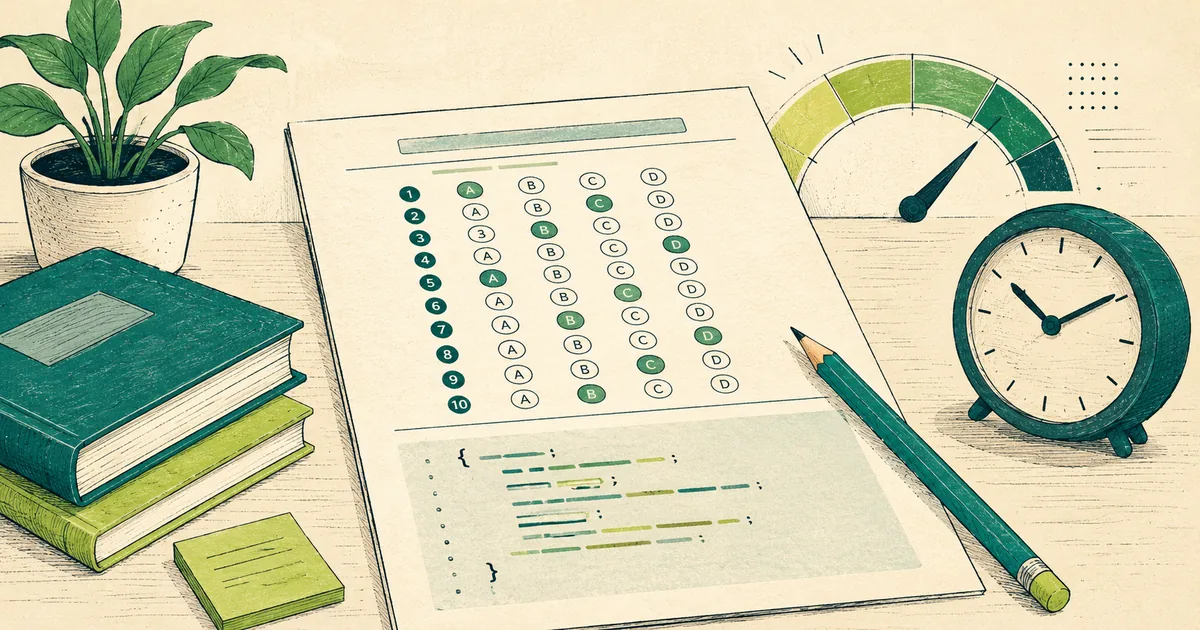
The AP Computer Science A (AP CSA) exam has two sections: multiple-choice and free-response (FRQ). Knowing the sections, their timing, and the FRQ types in advance lets you focus your studying in the right place. This guide summarizes the exam's structure and scoring.
Overall structure
The exam has two sections, each lasting 90 minutes — three hours in total. The exam is fully digital, administered in the Bluebook app.
- Multiple-choice: 90 minutes, 42 questions, 55% of the score
- Free-response: 90 minutes, 4 questions, 45% of the score
Section I: Multiple-choice
- 42 questions, 90 minutes, 55% of the score.
- Mostly individual questions; occasionally a small set of questions.
- The most critical skill is code tracing: following the code line by line and writing down variable values.
- There's no penalty for wrong answers; make a reasoned guess instead of leaving a blank.
Section II: Free-response (4 FRQs)
In this section, you write real Java code. The four questions typically cover these areas:
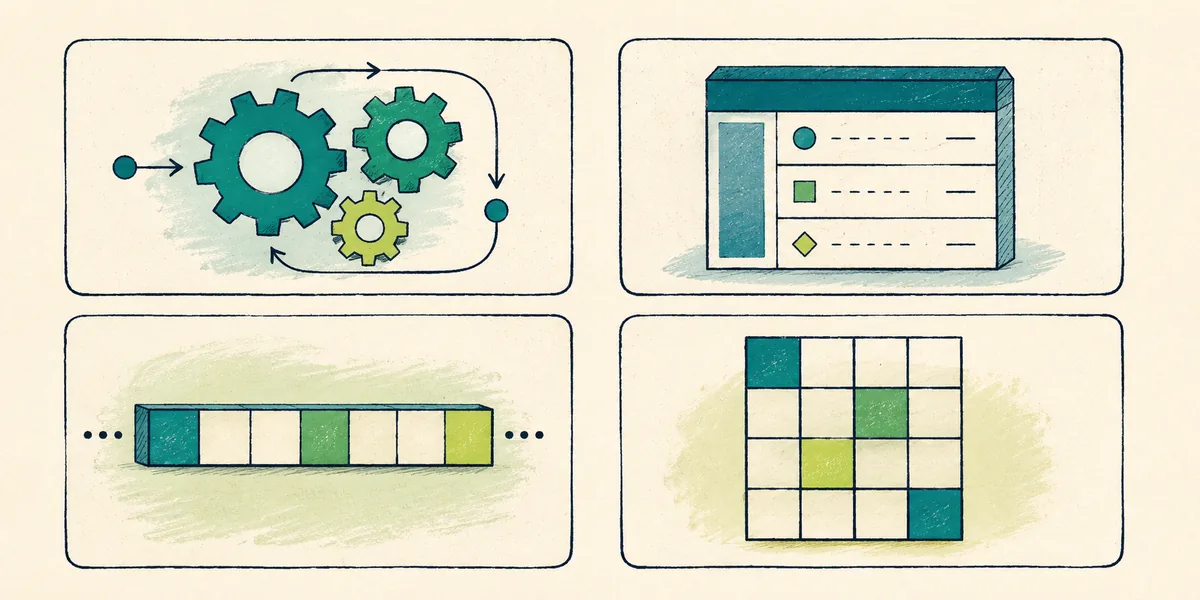
- FRQ 1: Methods and Control Structures: writing methods, conditionals, and loops.
- FRQ 2: Class Design: designing a class with a constructor, instance variables, and methods.
- FRQ 3: Data analysis with ArrayList: writing a method that uses and manipulates data in an ArrayList.
- FRQ 4: 2D Array: writing a method that uses and manipulates data in a 2D array.
Partial credit is possible on the FRQ, so instead of leaving a blank where you're stuck, try to build the correct structure as code.
Scoring and reference
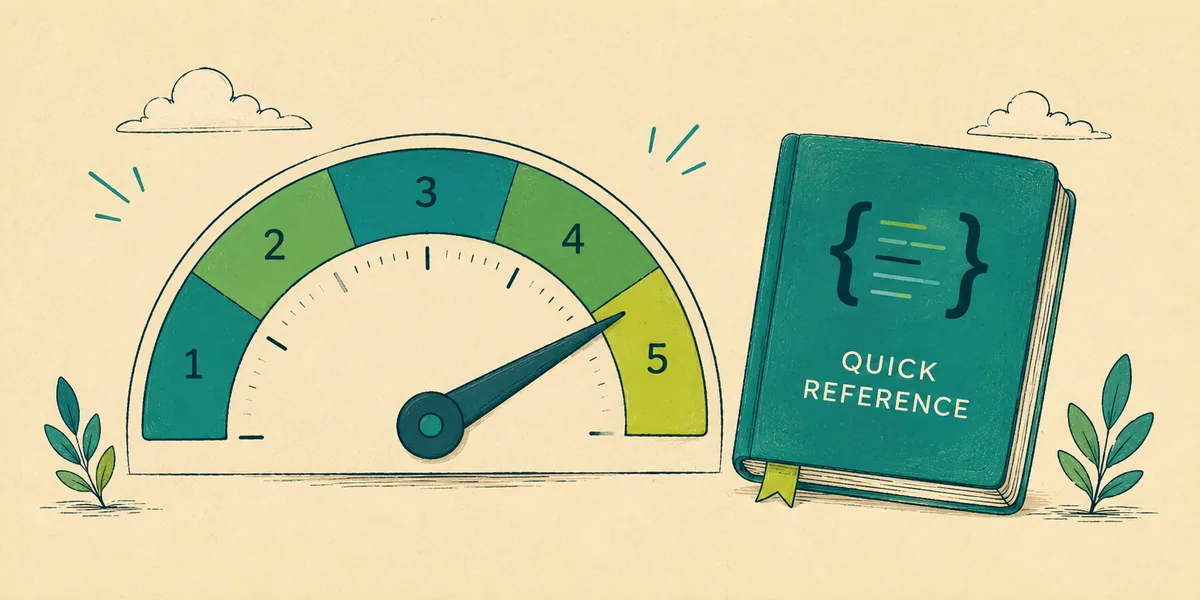
The multiple-choice section is machine-scored and the FRQ is scored by AP Readers; the two are combined — 55% / 45% — into a final AP score on the 1-5 scale. The single most useful preparation habit: solve past free-response questions, then compare your own answer against the official scoring guidelines. Having the right idea is not enough; points are lost in the detail, and the rubric looks exactly at that detail. A Java Quick Reference (a summary of commonly used classes and methods) is provided during the exam; you don't need to memorize it, but you should know in advance how to use it.
Section-by-section strategy
- Multiple-choice: Check edge cases (empty arrays, boundary indices) and eliminate wrong options.
- FRQ: Nail down the method signature and return type first, then write. Budget your time; don't get stuck on one question.
- General: Solve past FRQs under timed conditions; exam wording and time pressure are real factors.
Exam date and Bluebook
The 2027 AP CSA exam is on 12 May, runs for three hours, and is fully digital. A digital exam has one practical consequence: install Bluebook and run a practice test before exam day, not on it. Knowing how the app behaves, how code appears on screen, and where you can take notes makes a real difference under time pressure.
Language and prerequisites
The course uses a defined subset of Java — not the whole language. Having written code in another language helps, but on the exam you need to use Java syntax correctly; "I know the logic" is not enough.
There is no formal prerequisite. Three things make it easier in practice: English, algebra, and familiarity with the idea of a function. They speed up reading both the instructions and the problems.
Never having written code is not a blocker. Everything looks easy while someone else explains it; you see where you get stuck once you write your own code. So write small programs from the first week — noticing what you don't know early is an advantage.
The three most common preparation mistakes
Knowing the format does not by itself earn points. These three mistakes repeat even among students who know the format well.
- Leaving the content to the final months. New topics and practice exams end up squeezed into the same weeks, and both come out half-done.
- Skimming the small Java-specific rules. A single character changes the result — the difference between
<and<=, for instance. - Treating a practice exam only as a score. A practice exam is a diagnostic: it shows which topic and which question type you are losing points on.
What the exam actually measures
Behind the format question sits a more important one: in May, will you be someone who recognizes code, or someone who can write it? On AP CSA you will do both — the multiple-choice section tests the first, the free-response section tests the second.
On the reading side, the detail is what matters. Is the loop condition i <= 4 or i < 4? A single character changes the answer. That is the logic of AP CSA: understanding the general idea is not enough — follow the boundary condition and the value at every step.
Frequently asked questions
What is the AP CSA exam format?
Two sections, 90 minutes each: 42 multiple-choice questions (55% of the score) and 4 free-response questions (45%). Three hours in total, fully digital.
How many questions are on the AP CSA exam?
42 questions in the multiple-choice section and 4 questions in the free-response section.
When is the AP CSA exam?
The 2027 AP CSA exam is on 12 May. It runs for three hours and is fully digital.
Is the AP CSA exam still 50/50?
No. The course and exam were revised: multiple-choice is now 55% and free-response 45%. Account for that if you are studying from older material.
Is the AP CSA exam digital?
Yes, it is fully digital and delivered in Bluebook. Install the app and run a practice test before exam day.
Is there a penalty for wrong answers on AP CSA?
No. There is no penalty for a wrong answer, so make a reasoned guess instead of leaving a blank.
What do the four free-response questions cover?
Methods and control structures, class design, data analysis with an ArrayList, and 2D arrays.