The OWASP Top 10 is an industry-standard awareness document that summarizes the most critical security risks in web applications. This guide explains, in plain language, what OWASP is, what the Top 10 list represents, and the current 2025 categories.
What is OWASP?
OWASP (Open Worldwide Application Security Project) is a nonprofit community that aims to make software security accessible to everyone. It produces free tools, documents, and standards: the best known of which is the OWASP Top 10.
What is the OWASP Top 10?
The OWASP Top 10 ranks the 10 most common and most serious web application security risks, based on real-world data. It's not a list of every vulnerability, but a summary of the risk categories developers and organizations should prioritize. The list is updated periodically (for example, from 2021 to 2025).
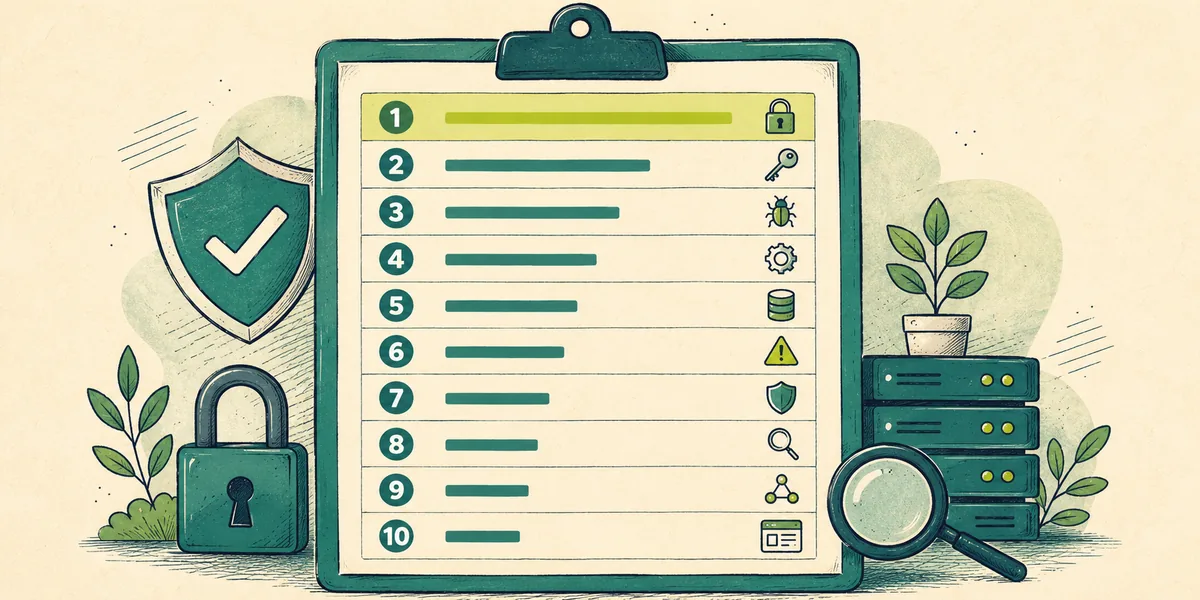
The current list (2025)
- A01: Broken Access Control: Users being able to access data or actions beyond their permissions. The #1 risk on the list.
- A02: Security Misconfiguration: Incorrect or incomplete security configuration (default settings, unnecessary exposed features).
- A03: Software Supply Chain Failures: Weaknesses in the software supply chain: untrusted dependencies, components, and build processes.
- A04: Cryptographic Failures: Weak or missing encryption; sensitive data not adequately protected.
- A05: Injection: Untrusted input being interpreted as a command/query (such as SQL injection).
- A06: Insecure Design: Weaknesses that stem from overlooking security at the design stage.
- A07: Authentication Failures: Weaknesses in authentication and session management (weak passwords, poor session handling).
- A08: Software or Data Integrity Failures: Integrity weaknesses: unverified updates, insecure CI/CD.
- A09: Security Logging and Alerting Failures: Insufficient logging and alerting; attacks going unnoticed.
- A10: Mishandling of Exceptional Conditions: Improper handling of exceptional conditions: poor error handling, "fail-open," and logic errors (new in 2025).
Why it matters
The OWASP Top 10 is a common language for secure software development. For developers it's a "what should I watch out for" list; for organizations it's a starting framework for a security program. Many security audits and compliance efforts also reference this list.
How to use it
The most effective approach is to use the list as a way of thinking rather than just a checklist: for each category, ask "where could this risk exist in my application, and how do I prevent it?" Secure design, input validation, least privilege, and regular testing reduce most of these risks.