
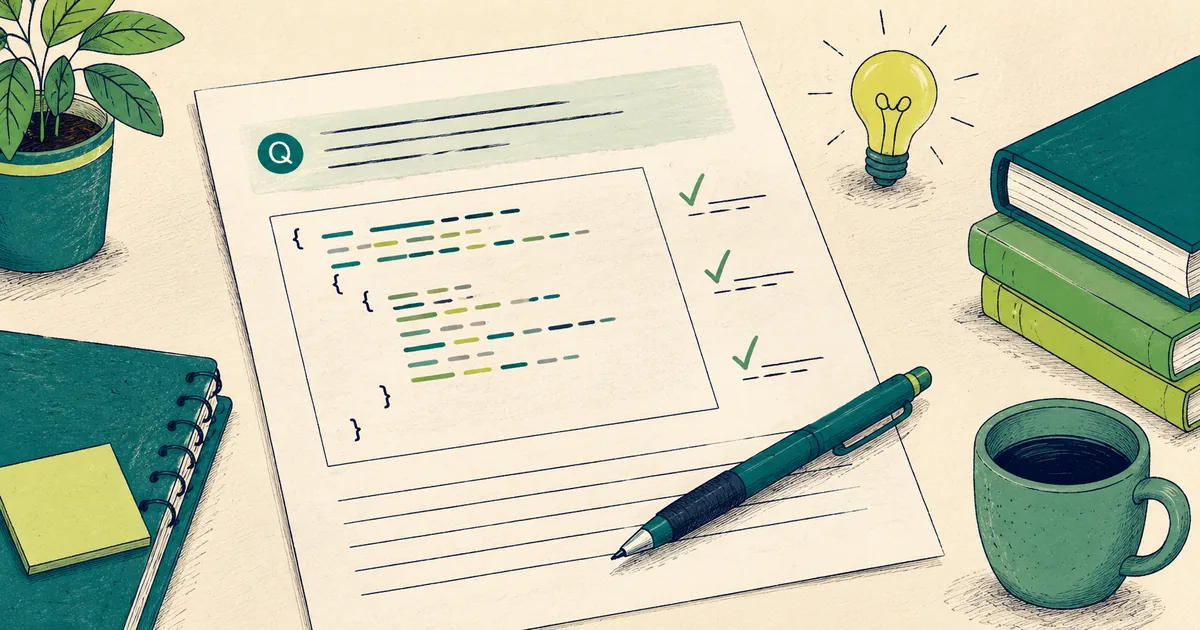
On the AP CSA free-response (FRQ) section, points come from building the right structure more than from perfectly working code. This guide summarizes a step-by-step approach you can follow when you sit down with an FRQ, and the Java mistakes that cost the most points.
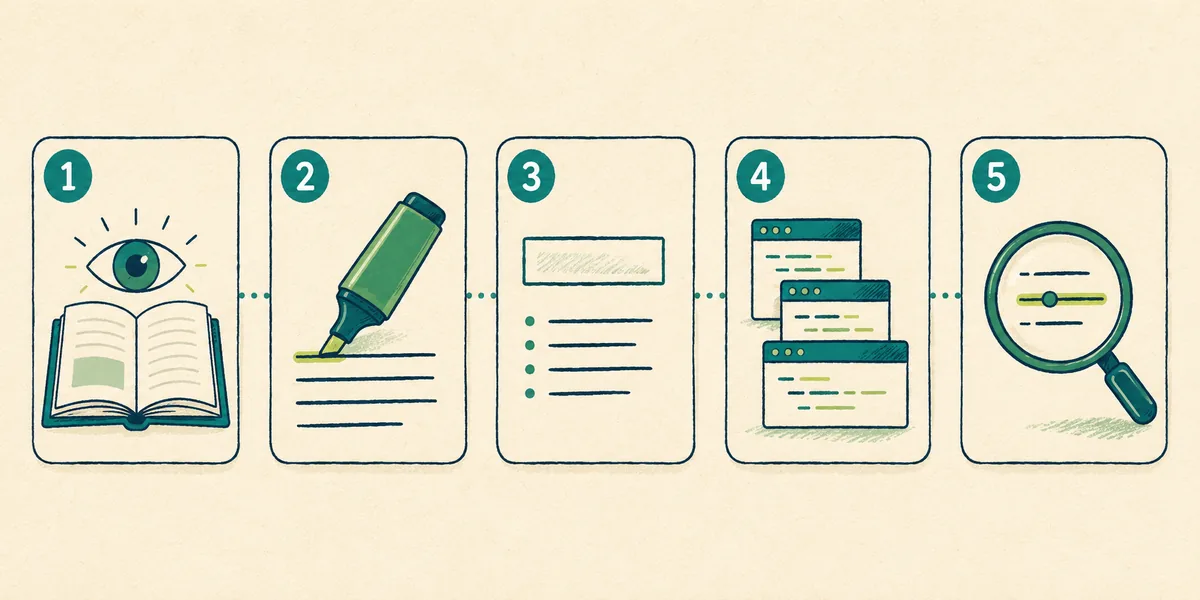
A step-by-step FRQ approach
- 1. Read the question twice: Restate what's being asked in your own words.
- 2. Mark what's given: Note the classes, methods, and sample outputs provided: use them exactly.
- 3. Write the signature: Fix the method name, parameter types, and return type first.
- 4. Build in small pieces: Construct the loop, condition, and return statement step by step.
- 5. Trace it mentally: Run your code on a small example on paper.
Read the method signature correctly
The most commonly lost FRQ points come from signature mistakes. Is the return type void, or does it return a value? What types are the parameters? Forgetting to return in a method that must return a value, or returning the wrong type, directly costs points. Match the signature to the definition in the question exactly.
Partial-credit strategy
Each FRQ is scored with a rubric, broken into small point pieces. So:
- Don't leave a blank where you're stuck; try to write the correct structure as code.
- Always write the parts you're sure of (loop setup, condition, return): each can be a point.
- Don't rewrite provided helper methods from scratch; call them. Reinventing the wheel wastes time.
Common Java mistakes
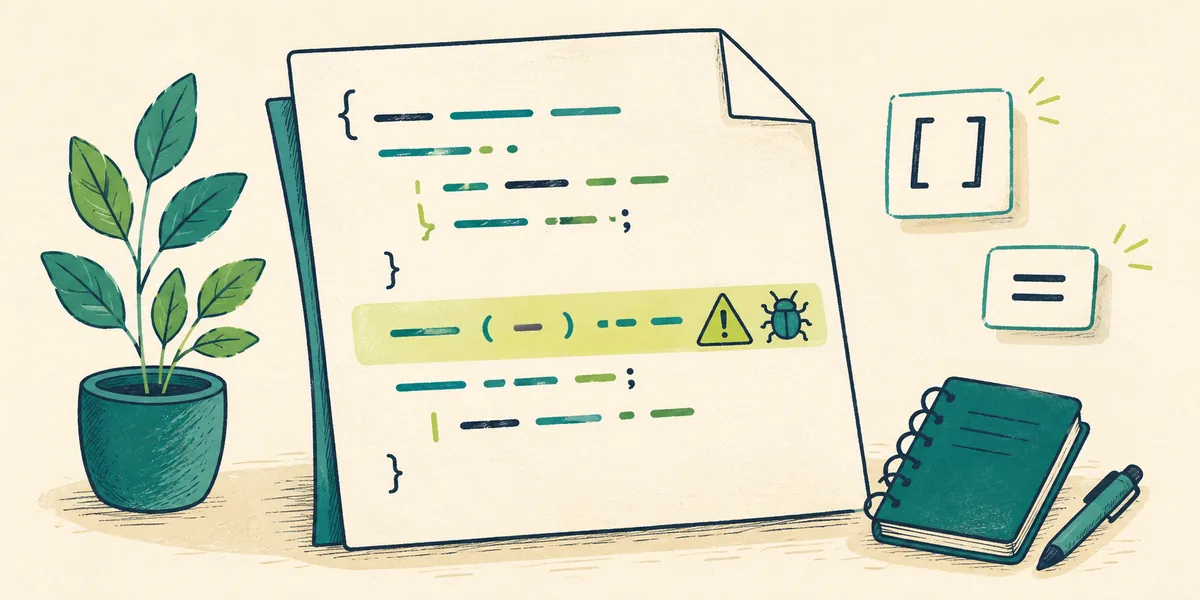
- Boundary / off-by-one: Confusing
<and<=in loop bounds; going out of array range. .lengthvs.length()vs.size():.lengthfor arrays,.length()for String,.size()for ArrayList.==vs.equals(): Use.equals()to compare objects (especially String).- String immutability: String methods return a new String; they don't change the original.
- Removing while iterating: Deleting elements while looping over an ArrayList causes index shifting.
- Confusing printing with returning: If the question wants a
return,System.out.printlnearns no credit.
How to practice
The most effective method is to solve past FRQs under timed conditions and then score your own answer using the official scoring guidelines. This teaches you how the rubric thinks, and you close recurring mistakes with an error log.
Where the FRQ sits in the exam
The FRQ is the second section of the AP CSA exam: 4 questions, 90 minutes, 45% of the score. Close to half the exam is decided here, and this section asks for something different from the multiple-choice: not reading code, but writing it.
The four questions typically cover:
- Methods and control structures — writing a method, conditionals and loops.
- Class design — constructors, instance variables and methods.
- Data analysis with an ArrayList — a method that processes data in a list.
- 2D arrays — a method that processes data in a two-dimensional array.
Budgeting your time across the four questions earns points on its own: getting stuck on one question means never writing an answer you actually knew. The full structure is in the AP CSA exam format guide.
Working with the scoring guidelines
This is the single most useful habit in FRQ preparation: solve past free-response questions, then compare your own answer against the official scoring guidelines. Having the right idea is not enough; points are lost in the detail, and the rubric looks exactly at that detail.
A comparison that works:
- Solve the question under time first, finishing without looking at the guidelines.
- Then open the rubric and mark the point pieces one by one: which line earns which point?
- For every point you missed, write a one-sentence note: "missed the return type in the signature", "set the boundary condition wrong".
- Collect those notes in an error log. After a few attempts you will see the same three or four mistakes repeating — that is where the real gain is.
MCQ practice and FRQ practice are not the same
On the exam you will both read code and write it. The multiple-choice section tests reading, the free-response section tests writing — and the two need different practice.
For reading (MCQ) practice, the critical skill is code tracing. A small example: a loop starts at 1 and accumulates — 1, then 3, then 6, then 10. It prints 10. If the condition were i < 4 instead of i <= 4, the result would be 6. That is the logic of AP CSA: understanding the general idea is not enough — follow the boundary condition and the value at every step.
For writing (FRQ) practice, you have to write your own code. Understanding an explanation is not the same as being able to do it yourself: you cannot learn to balance a bicycle by watching, and code is no different. The real learning happens when you open the computer, write the code, and see the error.
So the question is: in May, will you be someone who recognizes code, or someone who can write it? The answer starts with your next short practice session.
Frequently asked questions
How many FRQs are on the AP CSA exam?
Four. The section runs 90 minutes and is 45% of the score.
What do the AP CSA FRQs cover?
The four questions typically cover methods and control structures, class design, data analysis with an ArrayList, and 2D arrays.
How do I use the AP CSA FRQ scoring guidelines?
Solve the question under time first, then open the rubric and mark the point pieces one by one. Write a one-sentence note for each point you missed and collect them in an error log.
Is there partial credit on AP CSA FRQs?
Yes. Each question is scored against a rubric broken into small point pieces, so write the right structure as code instead of leaving a blank where you get stuck.
Which mistakes cost the most points on FRQs?
Misreading the method signature, boundary (off-by-one) errors, confusing .length / .length() / .size(), using == instead of .equals(), and printing when the question asks for a return.
How should I practice AP CSA multiple-choice questions?
By tracing: follow the code line by line on paper and write down the variable values at every step. Pay particular attention to boundary conditions.